The Police Had the Footage. They Were Looking at the Wrong Person for Two Years.
Kierra Michelle Coles had a lot to look forward to.
She was 26. She had just moved into her own apartment on the South Side of Chicago. She had saved up and bought her first car. She had worked her way from seasonal employee to permanent carrier at the U.S. Postal Service. And she was three months pregnant — excited about it, planning for it, telling her mother Karen all about the baby she couldn't wait to meet.
On the afternoon of October 2, 2018, Karen Phillips spoke to her daughter on the phone. Kierra was out shopping for baby supplies. She sounded happy.
That was the last time Karen heard her daughter's voice.
What the Surveillance Captured
That same evening, Kierra left her apartment on the 8100 block of South Vernon Avenue with a man. The two drove off in her car, Kierra in the driver's seat.
At 10:43 p.m., a Walgreens ATM camera on South Cottage Grove captured her walking in. She made two withdrawals — $400 in total — and handed the money to the man she was with. Her mother later said this was out of character. Kierra was careful with money, especially now that she was expecting.
Three minutes after she walked into that store, she walked out. That is the last confirmed image of Kierra Michelle Coles.
Less than an hour later, her car was seen parking in another part of the city. The man got out of the passenger side. Nobody got out of the driver's side. The car just sat there.
The next morning, he came back. He parked Kierra's car near her apartment block, walked into her building, and left carrying unknown items. Then he got into his own vehicle — which had been parked on the street overnight — and drove away.
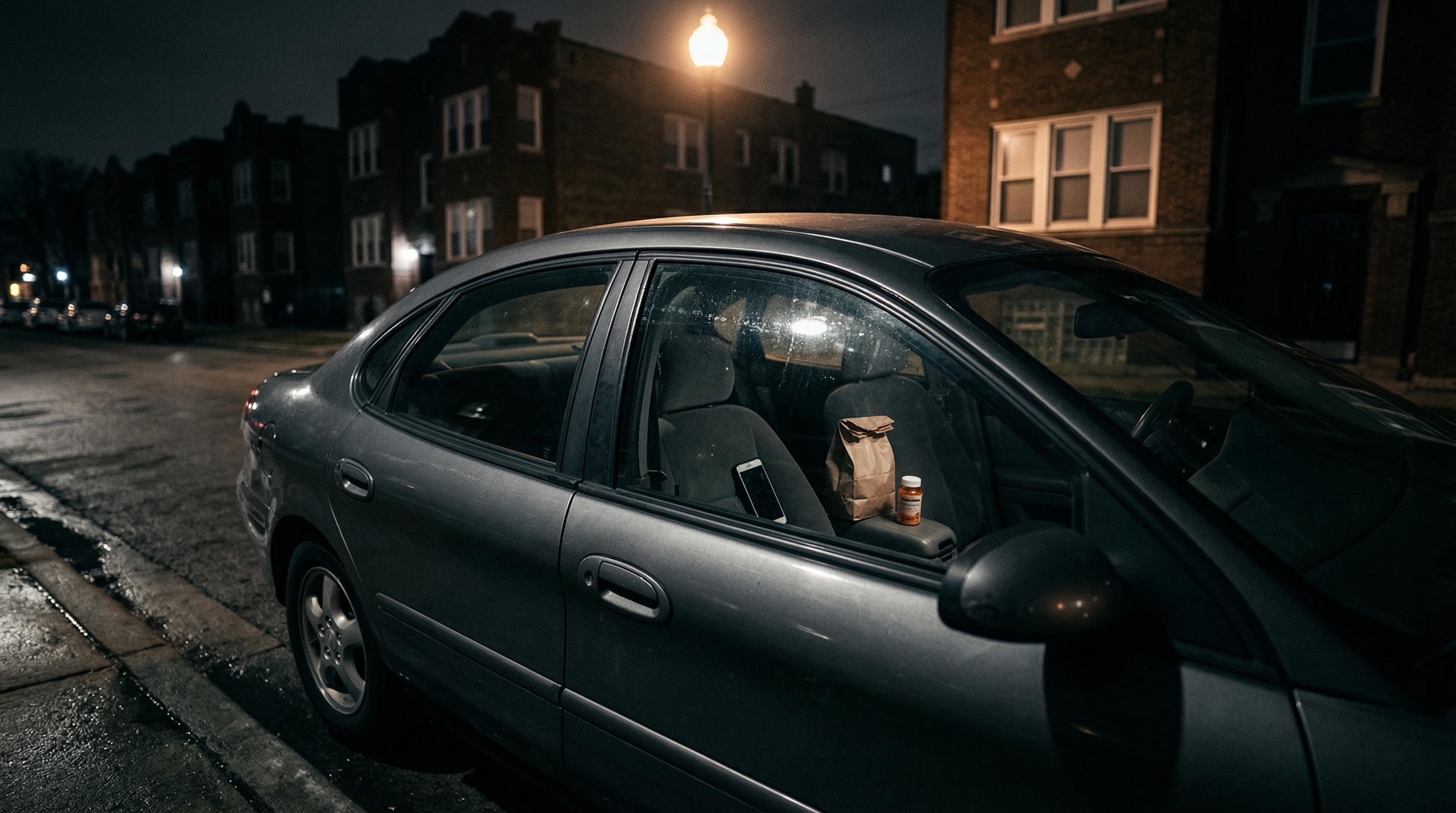
Inside Kierra's car: her phone. Her purse. Her prenatal vitamins. A packed lunch for a work day she never got to.
Karen reported her daughter missing that night. Kierra has not been seen since.
The Love Triangle Nobody Talked About
Kierra had been with her boyfriend for about six years. They worked at the same postal depot. He was the father of her unborn child.
He was also in a relationship with another woman — also a postal coworker, also pregnant at the same time. There had been tension between the two women for some time.
Chicago PD has never officially named a person of interest. But Kierra's mother identified the man in the surveillance footage as Joshua Simmons, her boyfriend. NBC Chicago found no criminal history in his past.
When police questioned him, he gave conflicting accounts of the last time he saw Kierra. He initially denied being with her the night she vanished. The surveillance footage proved otherwise.
Within days of Kierra's disappearance, Simmons and his other girlfriend both quit their postal jobs and moved out of state together. He did not pass out flyers. He did not attend any vigils or searches. He stopped cooperating with police.
Karen Phillips told NBC Chicago she had always considered him a decent man. Then she found out what he did in the days after Kierra vanished — quit his job, left the state with another woman, stopped cooperating with police. She told NBC Chicago that learning all of that changed everything she thought she knew about him.
Chicago PD told her early on that they had "a pretty good idea of what transpired."
That was in 2018. No arrest has been made since.
The Video That Set Everything Back
Here is where the investigation broke down.
In the days after Kierra disappeared, Chicago police released a surveillance clip. It showed a woman walking down the street in a U.S. Postal Service uniform. Detectives presented it as the last known sighting of Kierra Coles.
Karen Phillips looked at it and said: that is not my daughter. The walk was wrong. The height was wrong. The build was off.
Detectives confirmed she was right. The woman in the video was a neighbour — someone who lived on the same block and also worked for the postal service.
Here is the part that is hardest to accept: after confirming the error, police asked Karen to say nothing. They told her staying quiet would protect the investigation. So she did.
The public correction was not made until 2020. Two full years after the footage started circulating.
For two years, anyone who might have seen Kierra on the night she actually disappeared — in civilian clothes, not a uniform, in a completely different location — was never given the right description to recognise what they had seen. The witness memory window closed. The trail went cold.
Homicide Detective Lt. William Svilar later told NBC Chicago: "I think the last time we see Kierra, she is unfortunately not alive much longer after that."
He also said there was always a chance she had gone somewhere else.
What $68,000 Says About Whose Life Matters
In January 2026, an 84-year-old woman named Nancy Guthrie disappeared from her home in Tucson, Arizona. Her family announced a $1 million reward within days. The case received national media coverage almost immediately.
The reward for information on Kierra Coles, as of September 2025, stands at $68,000. It took five years to reach that number. The U.S. Postal Inspection Service contributed $25,000. The National Association of Letter Carriers added more. Private donations filled the rest, slowly.
Both women deserve to be found. Both families deserve answers.
But national media and law enforcement rallied around one case with speed and resources that the other never saw. Guthrie's family had a million-dollar reward within days. Kierra's case was officially suspended in July 2020, after 21 months, with police citing "exhausted leads."
The disparity is not just in media coverage. It shows up in the data too. The National Crime Information Center's missing persons files are about one-third Black — despite Black Americans making up roughly 13% of the U.S. population. That means Black people go missing at a rate far higher than their share of the population. And the national attention those cases receive is nowhere close to proportionate.
Natalie Wilson, co-founder of the Black and Missing Foundation, described the lack of progress in cases like Kierra's as "very disheartening." She told ABC News: "We have to do a better job of protecting Black women and girls."
Kierra Coles was a federal employee. She was pregnant. She had surveillance footage, a documented timeline, and a person of interest who gave contradictory accounts to police. She had everything that should have kept a case alive.
What she didn't have was a million-dollar reward announced within 48 hours.
Seven Years Later: A Retired Detective Refuses to Stop
In March 2026, retired Chicago detective Pamela Childs sat down with the Kierra Coles case file.
Childs is the subject of a new Investigation Discovery series called Hunt for the Missing: Chicago, which premiered on March 4. The first episode — "Shadows from the Southside" — is Kierra's story.
What Childs found when she went back through the evidence: a police investigation that went off the rails early and a secret relationship that had never been made public. Through that work, she took a step toward building a case around the person of interest Kierra's family has long identified — the same man Chicago PD has never officially named in seven years.
The full details are in the episode. What matters here is the fact that the details exist — that a retired detective, working independently, found new ground in a case that had been officially suspended.
Kierra's father Joseph Coles quit his factory job in Wisconsin after his daughter disappeared. He drove to Chicago and slept in his car outside her apartment for weeks, waiting for her to come home. He searched abandoned buildings on the South Side. He put up flyers. He refused to let her case become invisible.
Karen Phillips said it plainly to ABC News: "As long as I got breath in my body, I'm never gonna give up. I feel like if I give up, I'm letting her down."
What This Case Is Really About
The Kierra Coles case has all the elements that typically make a missing persons case a national story. Surveillance footage. A documented timeline. A person of interest. A federal agency involved from day one. A mother who has been publicly vocal for seven years.
What it didn't get was sustained national attention. The case dropped out of the headlines. The reward stagnated. The investigation was suspended.
The gap between what this case deserved and what it received is not random. It follows a pattern that researchers have named, that advocates have documented, and that the families of hundreds of missing Black women across the country have lived through in painful detail.
The evidence in Kierra's case did not disappear. The decision to keep pursuing it did.
Pamela Childs found new leads in 2026. A retired detective, working on her own time, found what a full police department with federal resources couldn't — or wouldn't — sustain.
That is the story underneath this story. It always is.
If you have information on Kierra Michelle Coles, contact the Chicago Police Department at 312-747-5789 or submit an anonymous tip at CPDtip.com. The U.S. Postal Inspection Service can also be reached at 877-876-2455.
Kierra Michelle Coles. Born September 24, 1992. Missing since October 2, 2018. Two people are missing — Kierra, and her child.